Somewhere along the way, modern design decided that sharp meant sophisticated. We disagree.
We understand how it happened. In architecture and furniture, everything tapers to knife-edges. The thinner the profile, the more refined the design. Corners are left unbroken because rounding them feels like weakness — a concession to practicality that betrays the purity of the form.
Veneer furniture made it worse. When your surface is a 0.6mm skin glued onto MDF, you can't sculpt meaningful curves. The veneer cracks, lifts, peels. So the industry embraced sharp geometry not because it was better, but because the material demanded it. Sharpness became the default.
The ENWA edge profile and charcoal oak grain — thin to the eye, soft to the hand.
But here's what we've learned working with solid wood: sharpness is a choice. It's not inherent to minimalism. It's not required for elegance. It's a convention.
Solid oak can hold a curve that veneer cannot dream of. An edge can taper to what your eye reads as razor-thin while your hand discovers continuous softness. The geometry can be precise, intentional, calculated — and still protect rather than threaten.
"What if an edge could look thin — feel minimal — but actually be soft?"
This isn't a compromise. A compromise would be sticking rubber bumpers on a sharp table. What we do is design the curve itself — using the same digital tools we use for buildings — so that safety and beauty are the same line, not competing forces.
The furniture industry will keep making sharp edges. They're cheaper to manufacture, easier to finish, and they photograph well. But the next time you run your hand along a table and feel that abrupt, hard corner — remember: someone chose that.
Your hand finds the edge. And doesn't want to leave. That moment is what we designed for.
01 — The Geometry
We took inspiration from an unexpected place: Apple. Look at the corner of an iPhone — it's not a simple radius. It's a squircle — a continuous curvature that begins changing direction long before you expect it to. Your eye reads it as perfection without knowing why.
We apply the same principle to furniture, but in three dimensions. The edge of an ENWA table starts curving far from where you'd expect — gently, gradually — so by the time you reach what should be a corner, there's only softness. Your eye still reads a clean, thin edge. Your hand discovers something else entirely.
Development drawings: Table corner detail (1:2) and table foot geometry (1:5)
We tested roughly two hundred variations. The challenge was the relationship between curves at different scales. The sweep of a tabletop edge. The taper of a leg. The place where they meet. Each had to feel like one continuous gesture, not separate decisions stitched together.
It always starts on paper. Before any digital model, before any prototype — just a pen and the question: how should this feel? The earliest sketches capture something CAD never can: the intent behind the curve. A 10-degree slope here. A 450mm seat height there. The word "curve" with an arrow pointing to the exact moment where geometry becomes comfort.
First sketches — the ENWA chair taking shape, curve by curve.
From paper to pixel. Every sketch gets tested in 3D — rotated, scaled, questioned. Does the curve read from every angle? Does the proportion hold at 1300mm and 3200mm? The screen captures below are raw and unpolished. That's the point. This is what design actually looks like before the photoshoot.
Raw 3D development — testing the Sen Dining Table at scale.
"The right curve isn't the one that looks best on screen — it's the one your hand doesn't want to leave."
02 — The Workshop
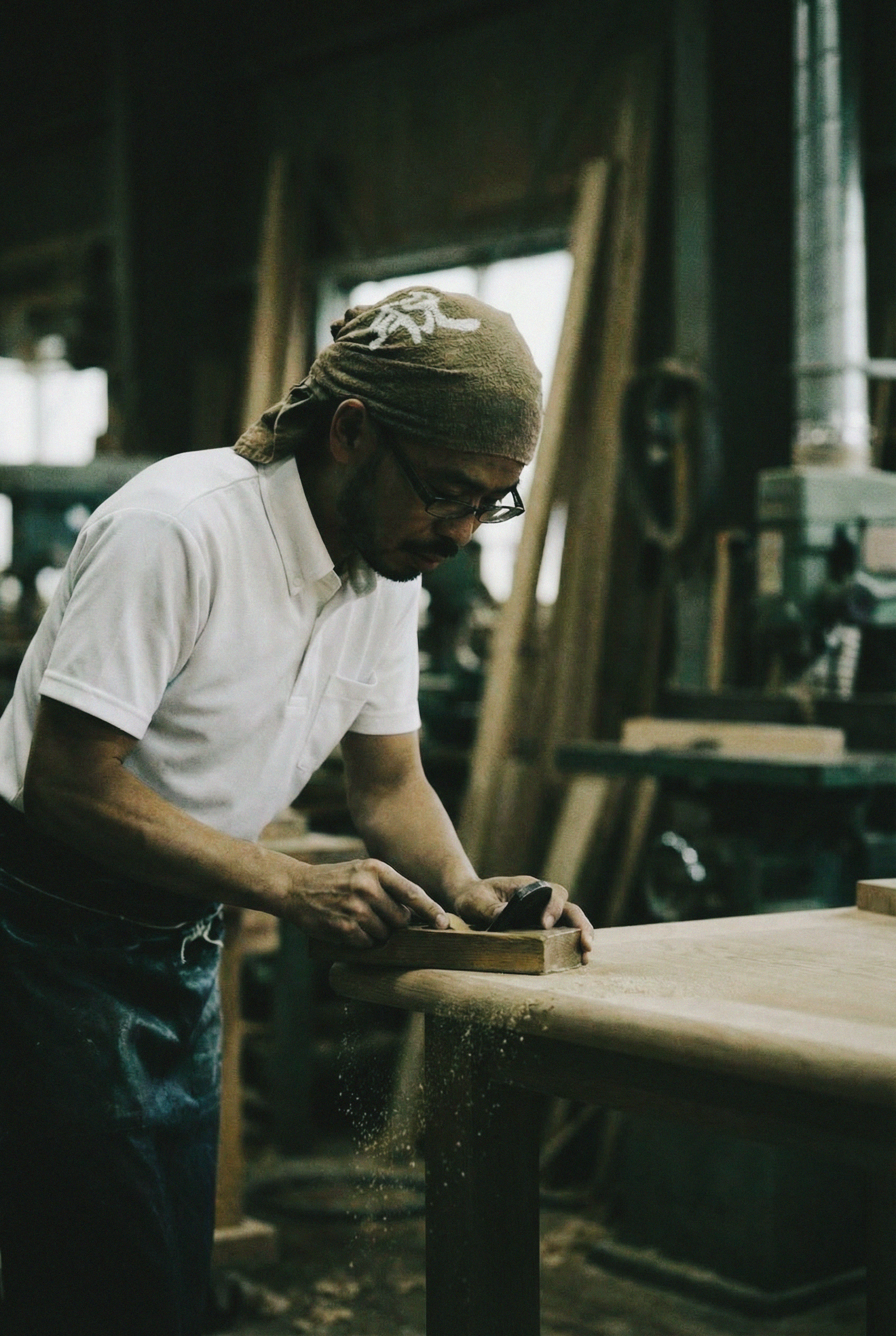
We found a team led by a master craftsman with over thirty years of experience working with solid wood. This wasn't a pitch meeting — it was a conversation about grain direction and moisture content and what happens to oak when the seasons change.
From raw timber to refined surface — cutting and hand-sanding North American white oak.
03 — The Material
Each piece begins with North American white oak — chosen for its grain. We want wood that tells a story on its surface. Every plank is different, and that's the point.
Oak samples in natural and charcoal finish alongside woven fabric — chosen for durability and warmth.
The timber is cut and joined, then left to stabilize. Solid wood moves — it expands, contracts, has opinions about humidity. Rushing this step means cracks later. We don't rush.
The digitally designed geometry is shaped from solid planks — rough at first. The curves we spent months refining now exist in physical form. This is where the machines stop and the hands begin.
For the next three to four days, the team refines every curve by hand. They follow the geometry we defined digitally but make the micro-adjustments that no machine can — the places where the grain changes direction, where two surfaces meet, where mathematics needs a human touch.
04 — The Finish
Each piece receives a water-based matte finish — three coats, with stabilization time between each layer. Water-based deliberately: it preserves the wood's natural texture while protecting it. The surface stays warm to the touch. The grain remains visible beneath. Nothing glossy, nothing synthetic.
05 — The Test
The final test isn't visual. It's tactile. We run our hands along every surface. The right ENWA piece makes you want to keep touching it — your hand moves back and forth along the curves, discovering the softness again and again.
The finished Sen Dining Table — where mathematics becomes emotion.
Sen Dining Table
North American White Oak · Charcoal Painted · 2200mm / 3200mm
We didn't set out to make furniture. We were architects.
For years we designed buildings — residences, resorts, bookstores — working across five continents. We understood how spaces shape the way people feel. How light enters a room. How circulation flows. How materials age.
But we kept running into the same problem: the furniture inside our buildings never matched the care we put into the architecture around it.
High-end European brands came close, but at prices that disconnected from the value delivered. Mass-produced pieces looked right in photographs but fell apart in reality — veneer peeling, joints loosening, surfaces that felt cold and synthetic to the touch.
In the middle — where good design meets solid craft meets real life — there was almost nothing.
"We kept designing spaces where every detail was considered — except the objects people actually touch."
As architects, we'd spent a decade learning digital design, material science, and structural engineering. We understood how forces move through forms. How geometry can be both precise and organic. How solid wood behaves across seasons and decades.
We realized we could bring architectural thinking to furniture — not as a marketing angle, but as a genuine design methodology. The same tools we use to shape buildings could shape a table leg. The same attention to how light hits a facade could inform how a finish reveals grain.
So we asked a different question: what if furniture was designed the way buildings are? With the same rigor. The same consideration for how people actually live. The same obsession with how a surface meets a surface.
That question became ENWA.
円和 — from 円 (en): circle, harmony, wholeness. And 和 (wa): peace, softness, Japan. Every piece flows without interruption. Every edge invites touch.
We're still architects. We still design buildings. But ENWA is where our philosophy becomes something you can hold.